How AI is Rewriting the Digital Strategy Playbook in the US
The era of treating Artificial Intelligence as a “shiny new tool” or an experimental playground is officially over. In 2026, AI will have become a standard operating procedure for digital marketers across the United States.
However, the rapid democratization of AI has birthed a massive challenge: content saturation and the “sea of sameness.” With everyone able to generate infinite content at scale, mediocrity has become commoditized. The winners in 2026 aren’t those using AI to replace human creativity—they are the ones using AI to eliminate friction while doubling down on human storytelling, data strategy, and community.
Here is how advanced AI is fundamentally reshaping content marketing, social media, and overall digital strategies in the US today.
1. Content Marketing: From Traditional SEO to GEO (Generative Engine Optimization)
The traditional goal of ranking on page one of Google with keyword-stuffed articles is obsolete. With the rise of conversational search platforms and AI Overviews, user intent has completely shifted.
-
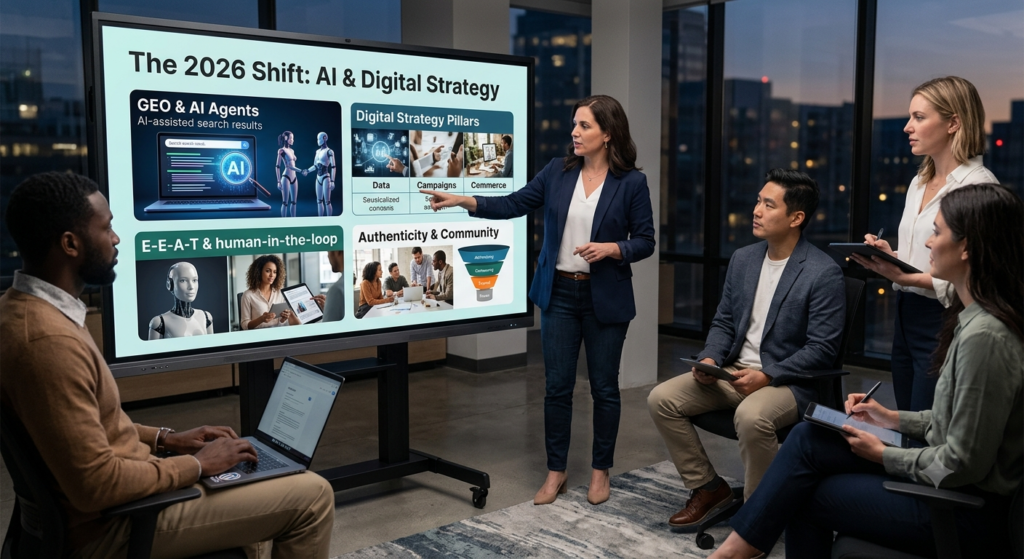
Optimizing for AI Agents: Marketers are transitioning from Search Engine Optimization (SEO) to Generative Engine Optimization (GEO). Strategies are now built to ensure that a brand is recognized, cited, and recommended by AI engines like Perplexity, Gemini, and OpenAI’s models.
-
The “Human-in-the-Loop” Mandate: Because AI can generate generic blog posts in seconds, search engines and consumers are hyper-focused on Google’s E-E-A-T guidelines (Experience, Expertise, Authoritativeness, Trustworthiness). Brands are adopting the “AI-as-Intern” method—using AI for data analysis, outlines, and first drafts, while human experts inject real-world case studies, proprietary data, and distinct brand voices.
-
Factual & Direct Content Structures: AI search models prioritize clear, verifiable facts. Content strategies have shifted away from “fluff” toward direct question-answering formats, structural FAQ patterns, and explicit schema markup to help AI models easily digest information.
2. Social Media: Community-First & The Battle Against Trust Collapse
The over-saturation of automated, AI-generated copy has led to what digital analysts call a “collapse in trust” online. In response, social media strategies in the US have radically evolved.
Micro-Communities over Mass Following
In 2026, volume is vanity. Brands are prioritizing quality over quantity, recognizing that a deeply engaged micro-community of 300 advocates drives higher conversion rates than 30,000 passive followers. Social strategies now focus on hosting private community spaces, interactive groups, and forums where real human connection takes place.
Unpolished, Authentic Creative
Slick, heavily produced corporate assets are being ignored. The best-performing social assets are raw, behind-the-scenes content—such as simple, phone-recorded employee introductions, workspace tours, and work-in-progress product designs. Authenticity has become the ultimate differentiator.
The Creator-Led Ecosystem
Instead of transactional, one-off influencer sponsorships, US enterprises are building integrated Creator Ecosystems. Brands treat creators as creative collaborators, bringing them into product development and brand storytelling early on to anchor marketing campaigns in genuine human trust.
3. Overall Digital Strategy: Hyper-Personalization and Agentic Commerce
At the macro level, AI has woven itself into the entire customer journey, forcing chief marketing officers (CMOs) to restructure their operating models entirely.
| Digital Strategy Pillar | How AI Has Transformed It in 2026 |
| Data Strategy | The near-total elimination of third-party cookies has forced a pivot to first-party data strategies. AI is leveraged to analyze consent-based data—like interactive quiz results or zero-party loyalty data—to create highly personalized marketing buckets. |
| Paid Advertising | Ad campaigns are increasingly autonomous. Machine learning systems handle dynamic bidding, real-time budget re-allocations, and infinite ad-copy variations. Human marketers have shifted their focus entirely toward setting creative boundaries and strategic guardrails. |
| E-Commerce | We are entering the age of Agentic Commerce, where consumer journeys are increasingly mediated by personal digital agents. Forward-thinking brands are optimizing their product catalogs and digital footprints so they can be seamlessly read and transacted upon by automated consumer assistants. |
Summary Action Plan for Brands
To stay ahead of the curve in this AI-driven digital economy, US marketing teams must pivot their resources from execution to strategy:
-
Stop broadcasting, start facilitating: Focus on building a community around your brand rather than pushing generic messaging.
-
Unify your marketing data: Ensure your CRM, analytics tools, and ad platforms speak to each other so AI engines can glean accurate predictive behavioral insights.
-
Balance technology with human change: McKinsey highlights that successful modern firms balance their tech investments with an equal investment in training human teams to interpret data, exercise taste, and manage AI workflows responsibly.
The future of digital strategy isn’t about AI replacing humans—it’s about humans using AI to unlock unprecedented scales of efficiency, leaving more room for the authentic creativity that captures consumer hearts.
For a deeper dive into how top global marketing leaders are balancing automation with authentic human storytelling, check out this insightful analysis, “The real signals from Cannes Lions 2026,” by McKinsey. This resource explains why moving beyond basic automation toward end-to-end workflow redesign is the ultimate growth driver this year.