The AI Multiplier: How Machine Learning Solves the ROAS Equation
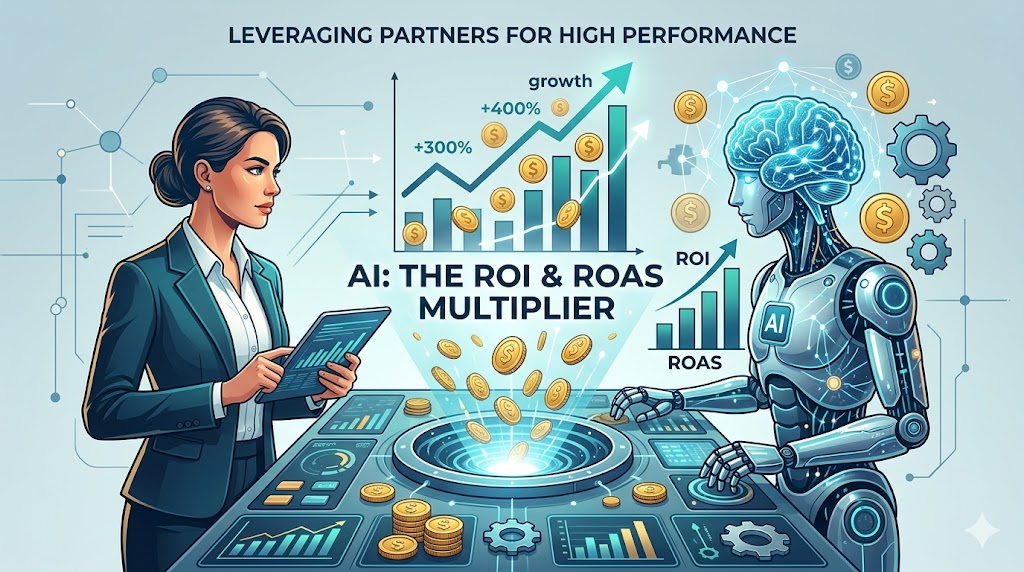
To understand why AI is a game-changer for ROAS, we have to look at the three core pillars of performance marketing: Predictive Audiences, Hyper-Personalization at Scale, and Real-Time Arbitrage.
1. Moving from Reactive to Predictive Targeting
Traditional targeting relies on historical data—what a consumer did last week. AI shifts the model to predictive behavior—what a consumer is likely to do next.
-
Machine learning algorithms analyze vast, disparate datasets to identify micro-segments of high-value users that human media buyers would completely miss.
-
By shifting budget away from “lookalike” groups and toward “high-intent predictive” audiences, ad waste drops precipitously, immediately driving up ROAS.
2. Creative Continuous Optimization
In paid media, creative exhaustion is the enemy of ROAS. Creative assets used to take days or weeks to conceptualize, design, and approve.
-
AI allows for multivariate creative generation at a velocity that matches consumer behavior.
-
More importantly, dynamic creative optimization (DCO) serves the exact right visual, hook, and call-to-action to a specific user based on their real-time context. You aren’t just running an ad; you are running the precise version of the ad that a specific individual needs to see to convert.
3. Smart Bidding and Cross-Channel Arbitrage
AI operates at a speed that humans cannot replicate. It can monitor cost-per-acquisition (CPA) fluctuations across Google, Meta, TikTok, and programmatic networks simultaneously.
-
Advanced AI attribution engines can instantly shift capital from a slowing Meta campaign to a surging Google Search intent trigger within milliseconds.
-
This level of algorithmic fluid budgeting ensures that not a single dollar of your ad spend is left idling in underperforming channels.
Why Technology Alone Isn’t Enough: The Critical Role of Your Agency Partner
Because AI tools have become heavily democratized, many businesses make the mistake of thinking they can simply purchase a few software licenses, hand them to an internal generalist, and watch their ROI skyrocket.
This is where campaigns fail. The software is just the engine; you still need an F1 driver to win the race. To truly maximize your marketing performance, you must lean heavily on an AI-integrated agency partner. Here is why:
Navigating the “Black Box” of Algorithmic Attribution
Modern ad platforms are increasingly hiding data behind “black box” solutions (like Google’s Performance Max or Meta’s Advantage+). If you let the platform’s native AI completely run the show without guardrails, it will optimize for its own revenue, not necessarily your bottom-line profitability.
The Agency Advantage: A sophisticated digital agency knows how to feed these platforms the right first-party data. They build custom data pipelines to ensure the platform’s AI is optimizing for true lifetime value (LTV) and net profit, rather than empty clicks or vanity conversions.
Bridging the Gap Between CRM and Paid Media
True ROI happens when your lifecycle marketing aligns perfectly with your acquisition marketing. Your agency partner should be using AI to connect your CRM data with your media buying engines. By analyzing post-purchase behavior, retention rates, and customer churn models via AI, your agency can tell your acquisition channels exactly what a “perfect customer” looks like, preventing you from wasting budget on one-time buyers.
Custom Prompt Engineering and Proprietary Models
Off-the-shelf AI tools produce off-the-shelf results. If your competitors are using the exact same public AI tools as you, your marketing will inevitably blend into a sea of corporate sameness, destroying your ad relevance scores and driving up costs.
An expert agency partner doesn’t just copy-paste prompts into ChatGPT. They build custom, proprietary workflows, fine-tune open-source models on your brand’s unique voice, and employ data scientists who ensure your creative output remains deeply human, highly strategic, and legally compliant.
The Bottom Line: Demand More from Your Marketing Capital
The gap between companies using AI natively and those using it superficially is widening into a canyon. Elevating your ROI and ROAS in today’s market requires an aggressive departure from traditional, slow-moving campaign management.
Do not ask your internal teams to become AI engineers overnight. Instead, challenge your digital agency partners. Lean on them to construct the data infrastructure, execute the predictive modeling, and scale the creative velocity that AI makes possible.
The businesses that win the next decade won’t be the ones with the biggest budgets—they will be the ones who partner with the smartest algorithms.